
Women of the Triempery

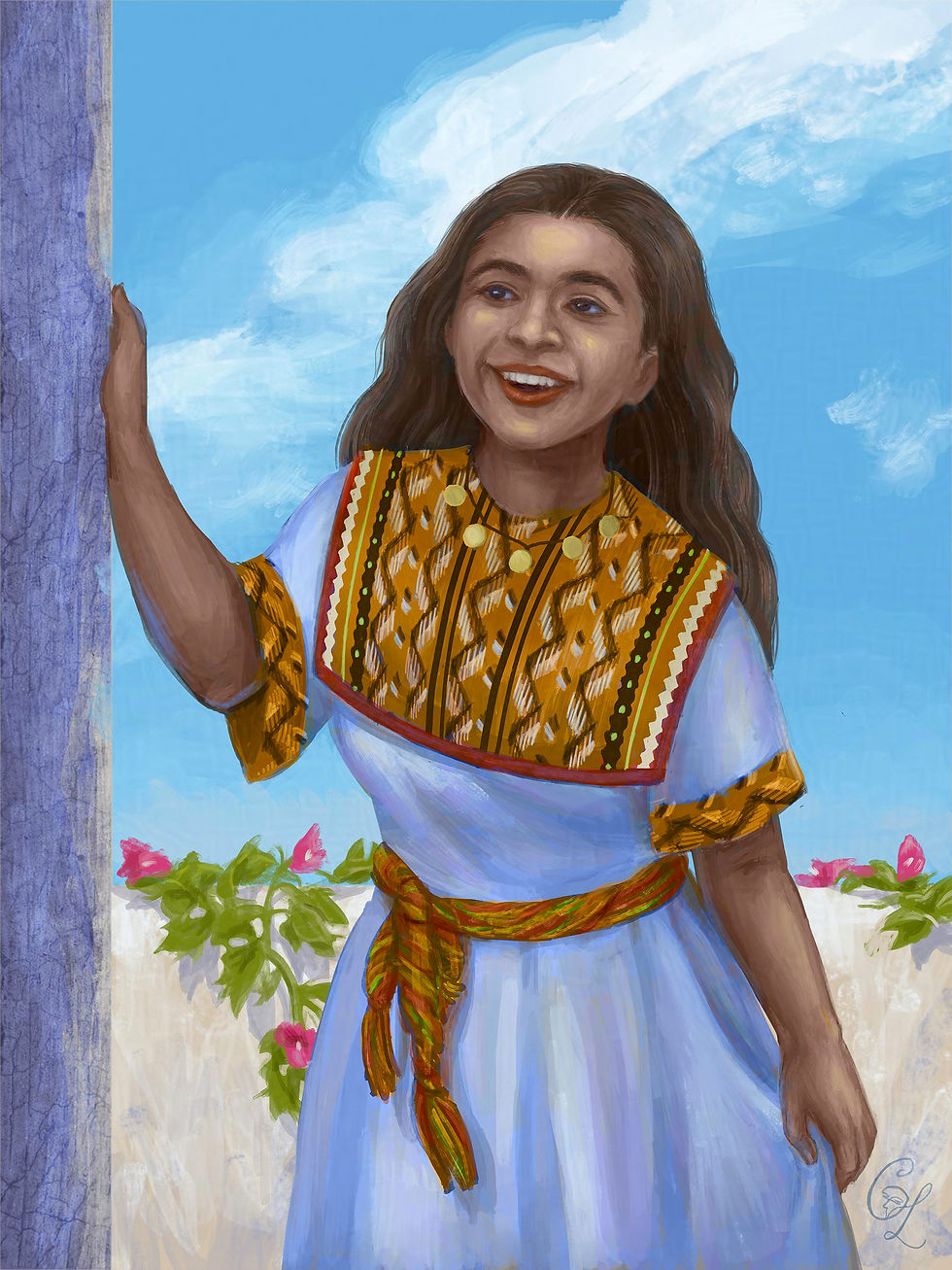
When I mentioned to my husband that I was writing a post about women in the Triempery universe, he said, “What? All two of them?” He later amended his remark to concede that there are three.
To be fair, there are more than three. It’s also true that it’s easy to underestimate the importance of women in the series. After all, the womenfolk aren’t as numerous—or flashy—as some of the male main characters.
For one thing, women are in fewer positions of power. Women also neither communicate with nor command the Entities. (Or do they? Let’s revisit this at the end of this post.)
The series presents entrenched patriarchies in its Staubaun-ruled empires but doesn’t deeply explore its existing matriarchy (Ardaen). Kheld women, though well-represented in the story, aren’t out to change the World, though they inevitably will.
So I am going to introduce some of the women and why I think they’re important.

Emyli Stauberg-Randolph
Easily the most prominent woman in the series, Emyli has her own blog post. She appears first in Sordaneon and is a POV character in every book of the series. A Princess of Essera, Emyli is the daughter of a king, Marc Frederick, and the mother of another. Indeed, of two. She has been a rebel, a healer, a leader, and a focus of contention for her kingdom and nearly all of its key players.
As characters go, Emyli is pivotal and, though readers may not know this at first, an awful lot of the story revolves around her. She grows and changes more than perhaps any other character—even Dorilian, for whom she is a catalyst and foil. Much as he is for her. Thematically, these two orbit each other. For this author, they’ve been a lot of fun. There’s a bit in The Kheld King where Dorilian proposes to marry Emyli. It could actually have happened. But I didn’t... they are much more fun at cross purposes.

Chyralane, Denizen of Phaer
Chyralane, leader of the Seven Houses, is another fun character. She too has her own blog post. Over a hundred years old, she’s nonetheless vital and calculating, a dangerous woman. In Sordaneon she steps into the series as an opponent of both Marc Frederick and the Sordaneons; readers learn later the full extent of her treacheries, which are deadly and many. She encounters teenage Dorilian, who becomes the focus for her plotting for the rest of the series.
Daimonaeris
Daimonaeris can be viewed as a victim but she is also a prime mover of events that drive and define the Triempery series. Though she doesn’t have a blog post, she deserves one—and I will eventually write that post. Beautiful and royal, Daimonaeris is half-sister of the series villain, Nammuor. She’s the daughter and only child of the last Highborn ruler of Mormantalorus and, as such, is the legitimate heiress. She should be Nuarchessa of Mormantalorus but instead she is Nammuor’s path to power. Daimonaeris is twenty-one years old when Nammuor weds her to Dorilian, a teenage boy. Together with Nammuor, she plots to usurp Sordan’s Hierarchate through her son and murder the godborn. Let’s just say that her existence in the story is impactful.
Ionais
Ionais Merrydeonaea is a secondary character, but she’s a secondary character with a sizable footprint. Daughter of a Highborn ruler and a cousin of Dorilian, she appears often, first as the betrothed of Marc Frederick’s son Jonthan, and in later books as the Princess of Merrydn. Politically significant and clever, Ionais is a ruler of importance. She interacts often with Emyli and Dorilian, who she does not like. She provides glimpses of Esseran royalty and culture, including her love for yappy little dogs.

Palimia
A powerless member of lower-ranking nobility, Palimia nonetheless makes major contributions to the story. Some readers may think she exists just so Dorilian can have a sex life but there’s nuance to their relationship. Palimia is introduced in Sordaneon as a victim of Essera’s occupation of Sordan and she is revictimized in The Kheld King when she’s forced to repatriate. Palimia was also, for one year, Marc Frederick’s mistress, and provides a connection to Dorilian’s memory of that man—a memory he is determined to protect. Most important, though some may miss it, is that Palimia greatly benefits Dorilian. Not only does she provide a generous sexual relationship to a man who doesn’t know how to have one, she nurtures connections in Essera that ultimately make possible Dorilian’s victory at Stauberg. Palimia is herself a hero.
Palaistea
Beautiful and high born, Palaistea appears most prominently in The Kheld King, but her impact begins in Sordaneon and carries through the remainder of the series. She is a catalyst for some events and the prime mover of one quite major one. She meets every series villain and hero, and she gives Emyli a run for the title of Best Mother Bear. Palaistea is never a POV character but her appearances are important enough to give shape to main plot arcs.

Aubrey Amundda
Aubrey and her friend Lark Rappeleye first appear in The Kheld King as fifteen-year-old girls presented as possible brides to Stefan Stauberg-Randolph. Readers don’t really see Kheld women until that book—and both Aubrey and Lark give much stronger representations starting in The God Spear.
As a POV character Aubrey takes readers deeper into what it means to be Kheld. Her role is cultural and thematic: Aubrey follows the teachings of the Mother. She is a Healer and Knower, a student of herbs and medicine and a reader of rune stones. She is also an example of a high clan—or upper-class—Kheld woman: she holds property and manages its economy; she’s responsible for the well-being of scores of families that live on her holding; she’s well-educated, reads and writes in three languages, and has been exposed to cultures other than Amallar. On many occasions she speaks for Neuberland in Kheld politics. In all these ways, she is possibly suitable for someone like Dorilian. If the Mother is up to something, Aubrey is part of it.
For anyone interested in knowing more, Aubrey has a blog post too.
Nilla Lowenda
Poor Silly Nilly. Other characters don’t give her many props but Nilla deserves closer examination. Born high clan, Nilla wants only what many Kheld women want, to be a wife and mother. The wife/mother role is highly respected in Amallar and Nilla has every right to desire it for herself. Educated in the Mother’s Way of Home, she trained to be a traditional Kheld woman, a holder of property and center of a large family. Stefan Stauberg-Randolph chose her for his wife because she exemplified those virtues. Nilla struggles to be the wife she thinks Stefan wants—and also the queen the men who surround her want her to be.
Noemi
Noemi appears early in Sordaneon and though she’s never a POV character and her role is never a large one, Noemi’s influence on Dorilian is outsized. Dorilian is seven and Noemi is sixteen when they meet and she becomes Levyathan’s wet nurse; she goes on to become Levyathan’s governess and caretaker, the person Dorilian counts on the most. He trusts Noemi with the most important person in his life—and as a result she becomes important to him also. Born to lower class parents, probably fisherfolk, Noemi finds herself a part of the Sordaneon household, surrounded by exalted persons. If she was cowed at first, she soon becomes accustomed. She speaks truth to the powerful, owns her own power, and through being herself she provides Dorilian with a model for caring, loving motherhood.
Asphalladra
Minor Staubaun nobility, Asphalladra is herself a teen when she meets Dorilian Sordaneon and Cullen Brodheson at Gustan. That she falls for Cullen and they become a couple is scandalous. During Stefan’s kingship the relationship was more tolerated, though both Kheld and Staubaun society frowned on the pairing—a stance that plays out in interesting ways. Though not a main character, Asphalladra illustrates how Staubaun and Kheld individuals, not their politics, provide a way their people can move forward.
Jereniell Hebdomonaea
Though her role is small, confined (for now) to The Walled City, Jereniell offers a glimpse of a Staubaun gentlewoman. Jereniell is noble, born into a lofty family so ancient and well-established they occupy a comfortable place. She is also well-educated and, perhaps unusual for a Staubaun aristocrat, a chemist and glassmaker—and an example that Staubaun women are much more than they often appear to be.
Fahme

Fahme is a baby in Sordaneon, Noemi’s child by Herlan (not Dorilian). She is adopted by Dorilian in The Kheld King. As a consequence, for the rest of the series Fahme is a Sordaneon princess, daughter of the ruling Hierarch. She grows up privileged, smart, brilliantly educated, and even more brilliantly connected. Her story going forward should be interesting.
Women and the Entities
While it’s not immediately clear in the series... women do communicate with the Entities.
The Entities are themselves... Entities. Leur genetics are neither male nor female but can present as either (or neither). Something to keep in mind.
To say more gets into interpretations of some aspects of the series, so I won’t do that. But one Entity definitely communicates with and is influenced by a woman. And another definitely will be.


Comments